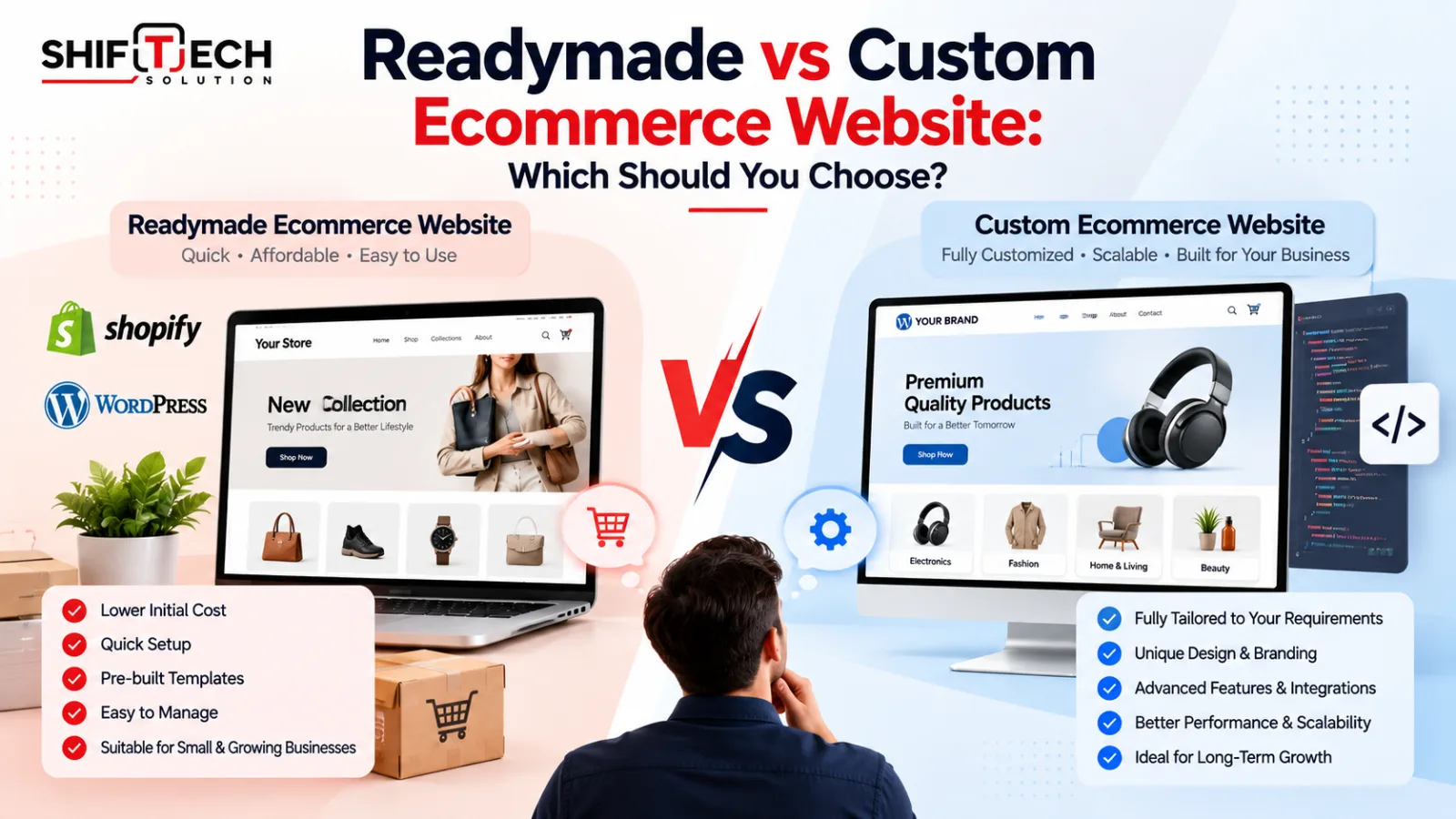
Before you spend a rupee on an online store, you need to pick a direction: use a readymade template or invest in a custom ecommerce website. Both are valid. The right choice depends on your catalogue, your budget and how you plan to grow.
This guide compares the two honestly, so you can choose without being pushed towards the more expensive option.
What is a readymade ecommerce website?
A readymade store is built from a template or a hosted platform. You pick a theme, add products, connect a payment gateway and launch. It is quick to set up and a good fit for small catalogues and simple selling.
The trade-offs are that your design and features are limited to what the template or plugins allow, you may pay monthly fees, and a heavy theme with many plugins can slow the site down.
What is a custom ecommerce website?
A custom ecommerce website is designed and coded around how your business actually sells. The layout, checkout, admin panel and integrations are planned for your workflow, instead of fitting your workflow into a template.
It takes longer and costs more to build, but you get exactly what you need and nothing you do not.
Readymade vs custom: side-by-side
- Launch time: readymade is faster. Custom takes a few weeks, depending on features.
- Upfront cost: readymade is lower. Custom is higher.
- Running cost: readymade often has monthly fees and paid plugins. Custom has no platform subscription, only hosting and maintenance.
- Design freedom: readymade is limited by the theme. Custom is unlimited.
- Speed: custom code can be lighter than a theme stacked with plugins.
- Integrations: custom can connect cleanly to GST billing, inventory or ERP software.
- Scaling: custom grows with your business without hitting platform limits.
When a readymade store is enough
Choose a readymade store if you are testing a product idea, have a small catalogue, need to launch within days, or have a limited starting budget. You can always upgrade later.
When a custom ecommerce website makes sense
A custom build is usually worth it if:
- You sell to businesses (B2B) with special pricing, quotes or minimum order quantities
- You need GST-ready invoices and stock that syncs with your billing software
- You have a large or complex catalogue with filters and variants
- You run multiple vendors or branches
- Speed and brand experience are central to your sales
- You want to own your system instead of renting features month by month
What about speed and SEO?
Page speed affects both conversions and search visibility, especially for shoppers on mobile networks. A readymade theme loaded with plugins can become heavy over time. A custom store carries only the code it needs, which makes it easier to keep fast.
For SEO, both options can rank, but a custom build gives you direct control over URL structure, product schema, internal linking and page templates. That control matters when you want category and product pages to compete on Google.
Five questions to help you decide
- How many products do I have now, and how many in two years?
- Do I sell at fixed prices only, or do customers get special rates and quotes?
- Do I need GST invoices or stock updates from my billing software?
- How important is a unique brand experience compared with launching fast?
- Would I rather pay monthly fees or invest once and own the system?
If most of your answers point towards simple selling and speed, go readymade. If they point towards control, integration and long-term savings, a custom build is worth a serious look.
A practical middle path
Many businesses start simple and move to custom once sales justify it. If you do, plan for it: keep clean product data, use your own domain, and choose a developer who can migrate products, customers and orders without losing search rankings.
How Shift Tech Solution can help
We build custom-coded stores in Vadodara for businesses across Gujarat and India, with secure payment gateways, an admin panel, GST-ready invoicing and product SEO. Shopping websites start at ₹20,000 with one year of domain, hosting and support. Learn more on our ecommerce development page or our GST billing and inventory software page, and read our guide on ecommerce website cost in India before you decide. When you are ready, contact us for a written quote.